- Home
- About AALHE
- Board of Directors
- Committees
- Guiding Documents
- Legal Information
- Organizational Chart
- Our Institutional Partners
- Membership Benefits
- Member Spotlight
- Contact Us
- Member Home
- Symposium
- Annual Conference
- Resources
- Publications
- Donate
EMERGING DIALOGUES IN ASSESSMENTLeveraging OKR’s for Institutional Learning Outcomes
December 9, 2025
AbstractThis paper develops a conceptual framework for operationalizing Objectives and Key Results (OKRs) to create Institutional Learning Outcomes (ILOs) for university systems managing wellness initiatives across multiple campuses. The framework integrates OKR methodology (Doerr, 2020) with organizational learning theory (Argyris & Schön, 1996) to establish measurable outcomes that capture institutional knowledge about effective wellness program adaptation, implementation, and coordination. Shifting the focus from purely student outcomes to integrate feedback-driven Institutional Learning Outcomes could help university systems capture what works, and why, so they can continually improve wellness efforts across campuses.
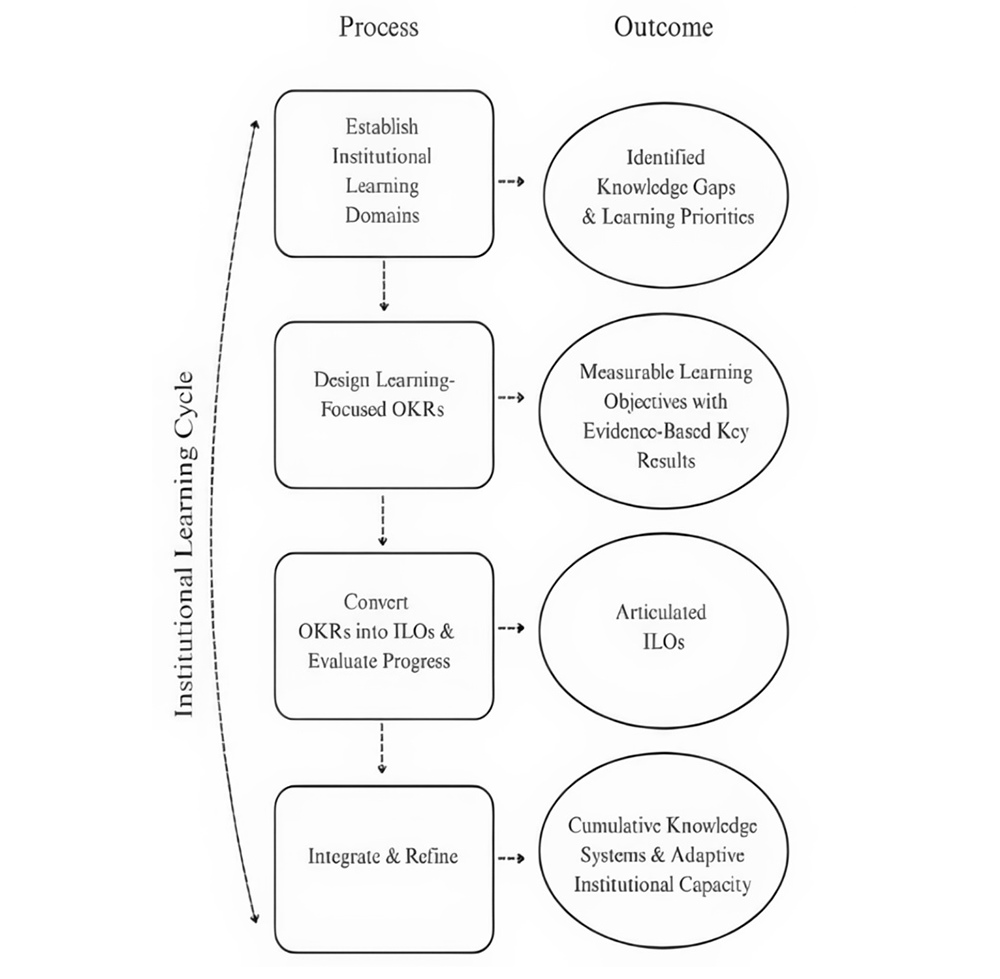
Introduction Higher education systems face complex challenges in coordinating wellness programs across diverse campuses. As student needs vary, system level approaches must be adaptive and evidence based. Yet most wellness programs still rely on campus specific outcomes, limiting institutional learning and obscuring opportunities for system wide coordination. Further, these approaches often neglect to evaluate what institutions themselves learn about program design and resource allocation, creating a significant gap in evaluation practice and a missed opportunity for university systems to apply insights gained through program implementation. Organizational learning theory offers a lens for rethinking how university systems approach wellness coordination. Rather than focusing on outcomes alone, institutions can use system wide strategies to share and apply learning across campuses. Achieving this requires tools that translate experiences into insights. Objectives and Key Results (OKRs) offer such a tool. This paper explores how OKRs can be used not only to track performance but to generate Institutional Learning Outcomes (ILOs). Understanding OKRs Objectives and Key Results (OKRs) represent a goal-setting framework (Doerr, 2020). In this framework, OKRs serve as a structured method for articulating institutional learning goals, which are then translated into measurable Institutional Learning Outcomes (ILOs). OKRs consists of two components: Objectives, which articulate specific institutional knowledge goals to be achieved, and Key Results, which provide the evidence base by offering measurable indicators that inform the resulting ILOs. When applied to ILO development, OKRs shift the focus from operational tasks to outcomes that reflect institutional learning. Doerr (2020) identifies four core principles particularly relevant to this context: objectives must address critical knowledge gaps, be specific and measurable using learning indicators, be verifiable through documented organizational learning, and be challenging enough to stretch institutional learning capacity. OKRs focused on institutional learning prioritize stretch goals aimed at advancing institutional knowledge. Partial achievement is treated not as a failure, but as evidence of learning in progress. This approach translates abstract concepts like “institutional knowledge” and “institutional capacity building” into specific, trackable results that document what the institution is learning through program implementation and how that learning informs coordination and improvement across multi-campus systems. Conceptual Framework: Integrating OKRs with Organizational Learning TheoryTheoretical Foundation The conceptual framework builds on organizational learning theory (Argyris & Schön, 1996), which posits institutions learn through iterative cycles of action, reflection, and knowledge integration that transform organizational routines and capabilities. Specifically, it draws on Argyris and Schön’s (1996) concept of double-loop learning in which institutions not only correct errors within existing routines (single-loop learning) but also evaluate and revise the underlying assumptions shaping those routines. In the context of multi-campus wellness initiatives, this might involve redefining program success around shared system-level goals, reframing the perceived divide between centralized and campus specific approaches as a source of adaptive strength, or integrating collaboration into cross-campus planning that is specifically designed to break down institutional silos. In university systems implementing wellness programs across diverse campuses, these learning cycles involve identifying effective practices, analyzing contextual factors influencing program success, and strengthening the System's ability to manage multi-campus initiatives. Nonaka and Takeuchi's (1995) knowledge-creating organization model provides additional theoretical grounding, emphasizing how organizations convert tacit knowledge from individual experiences into explicit institutional knowledge through systematic documentation and process sharing. This becomes particularly critical in multi-campus systems where successful practices developed on one campus must be evaluated, adapted, and transferred to other campuses with distinct institutional profiles. Framework Components The proposed conceptual framework consists of four interconnected components that systematically convert OKR methodology into Institutional Learning Outcomes for university wellness systems. The first component, Institutional Learning Needs, identifies specific areas where institutional knowledge development is critical for effective multi-campus wellness coordination. These domains may include cross-campus coordination mechanisms, adaptation strategies, and resource optimization across multiple campus ecosystems. The second component, OKR Development Processes, outlines systematic procedures for converting institutional learning needs into measurable OKR structures. The process begins with synthesizing institutional knowledge gaps within each identified domain and then formulating learning-focused objectives that directly address those gaps. Key results are then developed to capture evidence of knowledge acquisition, which informs the articulation of ILOs. ILO Development & Measurement Frameworks, the third component, establishes metrics and evaluation procedures for translating OKRs into explicit Institutional Learning Outcomes and for monitoring learning progress over time. Knowledge gained from key results tracking is used to derive ILOs that become the anchors for evaluation, linking the evidence of learning (key results) to the outcomes of learning (ILOs). Measurement approaches combine quantitative indicators of knowledge development with qualitative evaluations of learning depth and application. This dual emphasis supports both formative assessments for ongoing learning improvement and summative evaluations for documenting institutional knowledge gains and capacity development. The final component, Implementation and Sustainability Mechanisms, outlines institutional structures and processes required to sustain institutional learning beyond individual OKR cycles through the development and use of ILOs. It includes governance structures to oversee and adapt initiatives, knowledge management systems for capturing and disseminating learning across campuses, and continuous improvement processes that use insights from OKR implementation to inform ILO refinement. These mechanisms ensure ILOs evolve alongside institutional priorities, and that learning remains integrated into planning, decision making, and system wide coordination. The OKR Driven Institutional Learning Framework (see Figure 1) illustrates how institutional learning evolves through iterative goal setting, reflection, and knowledge integration. Figure 1: OKR to ILO Process/Outcome Model
The diagram illustrates how institutions can leverage OKRs to develop ILOs through an iterative learning cycle. Rectangles represent process phases while ovals denote the outcomes each phase generates. The feedback loop ensures that knowledge gained from implementation informs future learning objectives, building adaptive capacity where insights from each cycle strengthen the institution’s ability to coordinate and improve multi-campus initiatives and align them at the System level. Framework Application in University Wellness Systems Phase 1: Establishing Institutional Learning Domains The framework begins by identifying system-wide learning needs across critical domains of campus wellness. This phase focuses on uncovering institutional knowledge gaps that must be addressed to support system-wide improvement. Institutional leaders and stakeholders examine existing coordination challenges, knowledge silos, and inconsistent practices across campuses. An institutional learning need might be: “Determine the extent to which existing wellness program coordination varies across campuses and identify barriers to system-wide integration.” Phase 2: Developing Learning-Focused Objectives and Key Results Objectives are formulated to address identified knowledge gaps, and key results specify how learning will be tracked and applied over time. These metrics focus on institutional learning indicators such as successful knowledge transfer between campuses, documented insights from cross-campus collaboration, and evidence of institutional practice modifications based on reflective learning. For example, an objective might be to, “Build institutional knowledge on effective strategies for coordinating mental health services across campuses,” and a key result might be to facilitate two cross-campus working groups to analyze coordination challenges and identify successful practices. Phase 3: Converting OKRs to Measurable Institutional Learning Outcomes This phase translates institutional OKRs into specific ILOs that articulate what the organization will know, understand, and be able to do differently as a result of the systematic learning process. As key results are tracked, they generate concrete evidence of learning. These data points are then synthesized and reflected upon to articulate ILOs that define what the institution has learned. For instance, an ILO might state, “The university system will demonstrate enhanced institutional capacity to coordinate mental health services across campuses, as evidenced by the development and adoption of shared protocols and improved consistency in service delivery practices.” Phase 4: Implementation and Continuous Improvement Implementation requires establishing institutional structures that support systematic learning while maintaining operational efficiency. This phase may include quarterly reflection cycles that enable institutions to assess progress and adjust objectives based on emerging insights. This is consistent with Doerr's (2020) recommendations for OKR implementation. They generate feedback loops that reinforce routines and expand institutional learning capacity. Assessment and evaluation frameworks applied during implementation track progress toward Institutional Learning Outcomes using a combination of quantitative indicators and qualitative insights to evaluate learning depth, application, and impact. These mechanisms ensure that institutional learning remains visible and actionable across the university system. Framework Benefits and Expected Outcomes By focusing on institutional learning, this model equips university systems to manage the complexity of multi-campus wellness coordination more effectively. It also improves the transfer of successful practices across campus contexts by formalizing a mechanism for knowledge sharing. The framework promotes the cultivation of institutional learning cultures that prioritize systematic reflection, feedback, and knowledge application. Long-term institutional impacts may include strengthened evidence-based decision-making processes and scalable knowledge management systems applicable beyond wellness programming. Conclusion The conceptual framework leveraging OKRs to develop Institutional Learning Outcomes (ILOs) addresses a critical gap in how university systems coordinate multi-campus wellness initiatives. By shifting the focus from student outcomes to institutional learning, the framework enables institutions to systematically capture and apply organizational knowledge gained through program implementation across varied educational contexts. Integrating OKR methodology with organizational learning theory equips university systems with practical tools for translating implementation experience into institutional insights. As multi-campus university systems confront increasing demand for coordinated wellness initiatives, this approach offers a structured pathway to building institutional capacity. Through intentional, recursive learning processes translating insights gained from OKRs into ILOs that define what the institution has learned, how it has adapted, and what capabilities it has developed to sustain coordinated action, university systems can advance scalable solutions across multi-campus contexts. ReferencesArgyris, C., & Schön, D. A. (1996). Organizational learning II: Theory, method, and practice. Addison-Wesley. https://doi.org/10.1177/017084068000100310 Doerr, J. (2020). Measure what matters: How Google, Bono, and the Gates Foundation rock the world with OKRs. Portfolio. https://doi.org/10.1080/07347332.2020.1749212 Huber, G. P. (1991). Organizational learning: The contributing processes and the literatures. Organization Science, 2(1), 88–115. https://doi.org/10.1287/orsc.2.1.88 Nonaka, I., & Takeuchi, H. (1995). The knowledge-creating company: How Japanese companies create the dynamics of innovation. Oxford University Press. https://doi.org/10.1093/oso/9780195092691.001.0001 |

Upcoming Events
Wed Oct 21, 2026PASS: Who Did the Work? Direct Measures and AI-Completed Coursework in Program Assessment Category: Workshop |
Thu Jan 14, 2027SPARK Discussion: "The After Party: Reflection and Application" Category: Discussion Forum |
View Full Calendar
Conference Sponsors
|
NAVIGATION:
|
CONNECT WITH US Phone: 414-908-4945 © Copyright 2019-2026 Association for the Assessment of Learning in Higher Education. All rights reserved. |
|
Back to top